
Press felts
Endless and seamed constructions matched to the press position for sheet support, water handling and runnability.
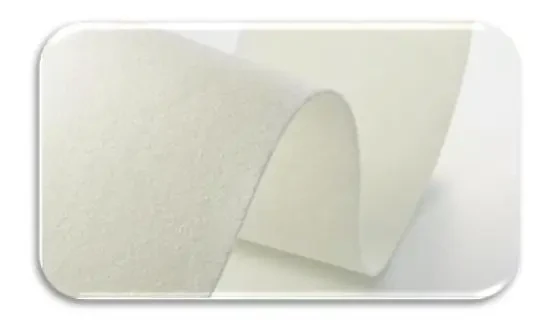
- Construction
- Laminated, multilayer and seamed constructions, with base fabric, batt and finishing specified for each position.
- Applications
- Packaging, board, tissue, graphical, pulp and specialty-paper applications, subject to a press-position review.
- Design focus
- Compaction resistance, elastic recovery, dimensional stability, cross-direction moisture and sheet quality.
- Design inputs
- Grade, basis weight, furnish, speed, press layout, nip load, dimensions, vacuum and showers.
Construction and reference specifications
The following information comes from the company manuals and brochure. Product-family ranges support selection discussions. Construction, test conditions and supply requirements follow the agreed technical specification.
Press felt product-family reference ranges
On smaller screens, swipe horizontally to view the full table.
| Application | Felt basis weight g/m² | Caliper mm | Air permeability cfm | Machine speed m/min | Sheet basis weight g/m² |
|---|---|---|---|---|---|
| Packaging paper | 1400–2200 | 3.5–4.2 | 50–90 | 700–1400 | 50–450 |
| Board paper | 1000–1900 | 2.4–4.5 | 70–120 | 300–1200 | 300–1500 |
| Printing & writing paper | 1000–1900 | 2.4–4.5 | 40–70 | 500–1200 | 40–120 |
| Tissue paper | 1000–1300 | 2.1–2.5 | 18–30 | 300–2200 | 11–30 |
| Pulp / suitable specialty grades | 1800–2800 | 4.8–5.7 | 100–200 | 80–300 | 300–1350 |
| Seamed felts | 1400–2700 | 3.5–5.7 | 20–180 | 200–1400 | 14–135 |
Permeability retains the source unit, cfm. Common test pressure, area and method are not stated and must be agreed before comparison or acceptance. Speed and sheet-weight figures describe application ranges, not guaranteed performance at every position.
Source: company brochure, PDF pp.26–31 (printed pp.25–30); product manual, PDF pp.5–8. Tissue felt ranges also appear in the tissue-felt presentation, slide 8.
Match the fabric to the machine position
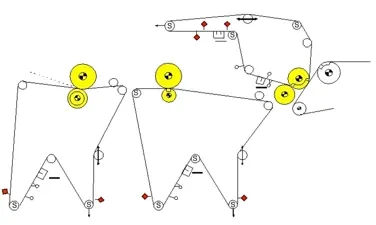
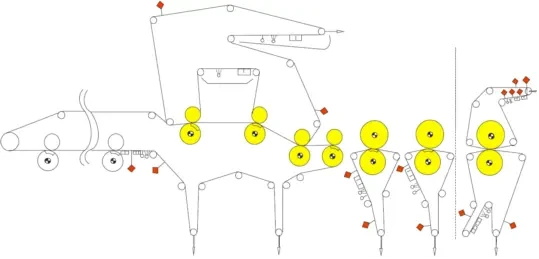
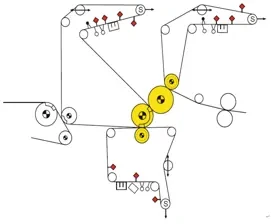
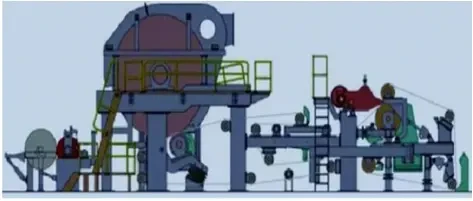
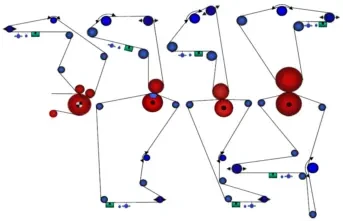
Illustrations are extracted from the supplied company manual and brochure. They show typical machine positions or felt runs, rather than the actual configuration of every machine.
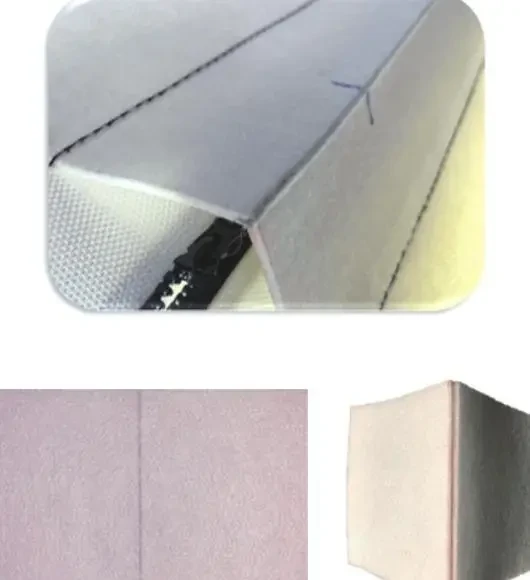
Seamed constructions for the position
Single- and double-seam felts are reviewed against installation access, pintle configuration, batt coverage and sheet-quality requirements.
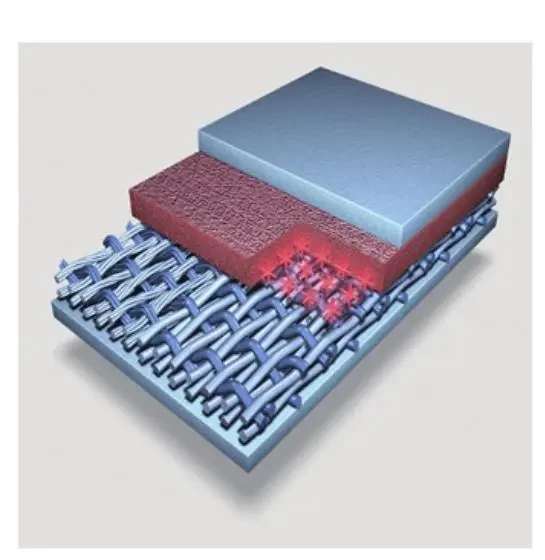
Discuss a seamed feltA construction that works together
Sheet-side batt
Support the sheet uniformly, with fibers and surface selected for sheet requirements.
Intermediate batt
Integrate the base and batt while balancing water transfer and pore structure.
Base fabric
Provide mechanical support, dimensional stability and drainage channels.
Machine-side batt
Protect the base and work with roll surfaces and felt conditioning.
Schematic only. Actual layers, materials and construction follow the agreed specification.
Start with your next machine position
Share the grade, operating conditions and current performance for an informed selection.